Peoples’ Global Action
Oral History Project
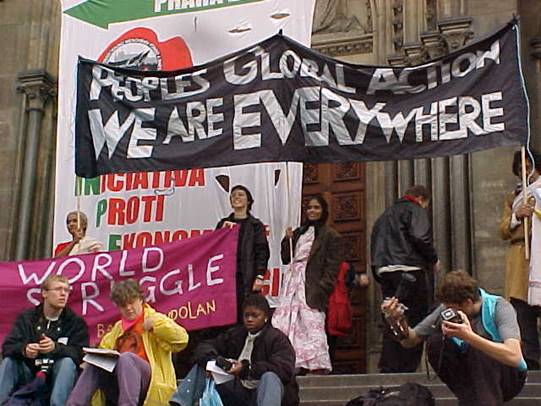
Peoples’ Global Action was the initial linking network that inspired the decentralized Global Action Days against corporate globalisation, including the blockades of summit meetings for elite coordination between 1998 and 2005. It played a key role in initiating the confrontation of peoples’ movements with the corporate globalisation implemented by the World Trade Organisation, World Bank, and International Monetary Fund. This website presents interviews from those involved in the Peoples’ Global Action.
PGA was the transnational network of grassroots movements that formed the origin of the alterglobalization protests. Emerging in the mid-1990s from the solidarian networks in the course of the intercontinental meetings of the Zapatistas in Chiapas, Mexico, PGA brought together actors as diverse as the Maori from Aotereoa (New Zealand), fishermen from the Philippines, farmers’ associations from India, environmentalists from Russia, the Tute Bianche from Italy, Ogori from Nigeria, women workers exploited in El Salvador’s world market factories and the postal workers’ union in Canada. The first official international PGA conference in February 1998 was attended by 400 people, mainly delegates from their organizations, from over 70 countries. Three months later, on the occasion of the second WTO ministerial conference in Geneva, the local police chief spoke of a “new 1968”, the first Global Street Party took place, as well as coordinated mass events in Brazil, India and elsewhere.
Never heard of PGA? We had no office, no employees, no finances beyond donations for individual actions. While some of us were in the school in Genoa that was brutally attacked by the police in July 2001, NGO’s had their press offices open and became the face of the movement. But our invisibility was also due to something more: PGA was the networking of mainly the most marginalized and most radical movements worldwide – those who are not heard because what they have to say is not asking for more money or participation in the wrong system. Instead, their perspectives boil down to the fact that it is the system in its basic logic that is wrong. That we need a radically different, a radically more beautiful world.
This website provides the opportunity to gain insight into the struggles of that time: Over the years, dedicated individuals have conducted in-depth interviews with people who were involved in those struggles in many places across different continents. This has resulted in a multifaceted picture of those struggles—one that might inspire us today to build a similar network?
The Hallmarks of the PGA were
-
A very clear rejection of capitalism, imperialism and feudalism; all trade agreements, institutions and governments that promote destructive globalisation.
-
We reject all forms and systems of domination and discrimination including, but not limited to, patriarchy, racism and religious fundamentalism of all creeds. We embrace the full dignity of all human beings.
-
A confrontational attitude, since we do not think that lobbying can have a major impact in such biased and undemocratic organisations, in which transnational capital is the only real policy-maker;
-
A call to direct action and civil disobedience, support for social movements’ struggles, advocating forms of resistance which maximize respect for life and oppressed peoples’ rights, as well as the construction of local alternatives to global capitalism.
-
An organisational philosophy based on decentralisation and autonomy.